Most of you know that in addition to Penumbra Media and Design, I also have a retail shoe business. Today, we had the typical customer. The one who knows exactly what they want and everything else is ugly.
But what was fun about today is that we had 2 customers sitting next to each other (they were not together) and one hated the shoes and tossed them to the floor. They happened to land next to other lady and she immediately picked them up and exclaimed, "this is exactly what I was looking for!"
Isn't it amazing, no matter how hard we try, we cannot please everyone. For some what we do is perfect. For others, it sucks. the same is true in culture change. In fact, in culture change, it is the rule of 1/3rds. A 1/3rd of your employees will adapt quickly to the new direction, 1/3rd will fight the change and try to keep it from happening and 1/3rd will ride the fence waiting to see which 1/3rd wins out.
Unfortunately for too many companies the lower 1/3rd win and no change ever takes place. But according to the stats 1 out of every 3 employees will not support your culture change. That's scary - but true. The good news is that if we know this going in, we can plan for ti and be prepared. This is the reason we always say that driving culture change it like driving the bus in the movie Speed - never slow down once you get started.
By the way, statistics say that 1 out of every 3 people is ugly. So look to your left and look to your right. If you don't see any ugly....
Friday, October 31, 2008

Tuesday, October 28, 2008
Politician Say What?
Are you starting to feel like its time for this election to be over and that we need to move on? Well, I do. The last weeks of a national campaign (or any campaign for that matter) turn so negative and "off-topic" it is disgusting. Not because we get tired of hearing all the he said she said stuff, but because eventually one of these two men will be the President of the United States. And all of the negative name-calling and political misdirection will leave part of the country doubting our new leader.
Whether you are a Democrat, Republican or other party supporter, today's blog is about culture in political parties. Remember when the Republican party was about the conservative christian right? Not today. No conservative christian would pull the stunts the RNC is pulling right now. A conservative christian would stay on topic and stick to the issues and not let petty things take over. (At least they are supposed to.)
So watching the dramatic shift in campaigning for the RNC since Karl Rover took over several weeks ago leads us to ask, "Is the Republican party about conservative, ethical, moral values or about getting elected at whatever the cost?" Because in the last weeks, this last thought is all that this campaign has been about.
Say what you will about our current President, but he has stayed consistent to his conservative christian values. His strategies may not have worked, but he has been consistent and he has not changed with the wind.
Now, my intention is not to trash one party and sound like I am supporting the DNC over the RNC. Not at all, The DNC has made its share of mistakes as well. But this recent change in behavior by the candidate and the party really have me asking, "Is this the true culture of the RNC or just the culture of a few that will be rejected after the outcome?"
What we do know, is that if it is the true behavior and value system of the RNC, then it has changed. I think its not the true nature. Honestly, I think this attempt to win at all costs is going to cost the RNC this election.
And when it is all said and done, they should have stayed true to their corporate culture. They will find themselves no different than the Fortune 500.
Saturday, October 25, 2008
Mission Statements and Parachutes

A mission statement that is not known by the people (placed on their hearts and heads) is about as useful as a parachute on the first bounce.
 We thought it would be intriguing to find out how many people really know their company’s mission statement. Over the past two years, asking people we came in contact with in all parts of our lives has become a norm for us. It’s very hard to serve us food in a restaurant or rent us a car or check us into a hotel without being asked, “What is your company’s mission statement?” We even took it so far as to call companies out of the yellow pages a couple of afternoons to ask the people we got on the phone what their company’s mission statement was. (This was the fun part because at times we posed as a radio deejay or as a braniac professor from Harvard. It was very hard to get people to take us seriously without the ploys!)
Well, throughout this investigative research process, we have come to this conclusion.
More people know the mission statement of Star Trek than know their own company’s mission statement!
(Now there’s a quote for you!) It’s true! We started asking people what the Star Trek mission statement was and they knew it! Oh, please! Don’t sit there reading and try to pretend you are not “boldly going where no man (or woman to be PC) has gone before!” You probably struggled with our first question, “What is your company’s mission statement?” but had no trouble with the Star Trek part. That’s okay if you’re Gene Roddenberry, but it really doesn’t do a whole lot for the profitability or service of your company.
Why do people know the Star Trek mission statement? The main reason people know the Star Trek mission versus their company’s is that they had actually heard the Star Trek one! Our experiences showed employees are never even told the mission statement of the company let alone their mission as a part of the company. Is it any wonder that people will give you only their hands and feet at work? If all I do is wait tables at Red Robin restaurants, then what are my chances that I will make a “happy guest”—which is their product?
Red Robin International is a great example of a company that has tied its mission statement to its marketing. They used to print on the front of every napkin this mission statement: “We create happy guests.” Definitely a page out of the Disney book, but who cares. Steve Udhus, Vice President of Operations for Red Robin says, “There is no set culture that you can go out and buy. But there is a blueprint (roadmap) that you can follow that builds and molds your culture successfully. We studied and benchmarked the best to discover the blueprint, but we had to do the building ourselves. Our culture is unique, distinctive, and of service.” We have found that it works and every employee of Red Robin knows that their job is to create happy guests, whatever it takes.”
Wednesday, October 22, 2008
Vision

In our research, the terms “vision statement” and “mission statement” are used interchangeably by everyone. It’s as if what matters is whose seminar you attended or which book you just finished reading as to which term you use for your company. But for purposes of building a Culturrific! service team, we have found that these terms really represent two very different ideas with two very distinct and important purposes.
Your vision statement is the set of values, beliefs, and ideals you want to weave into the fabric of your culture. In the “Culture Cycle” chapter, we discussed how this “weaving” takes place. It is not enough to write down your values or beliefs on paper. You must program them into your culture. But one of the key stumbling blocks for many companies is they fail to put in writing what they mean. They feel that vision is a trendy buzzword. In fact, a vision is a unique design of the future.
Most vision statements usually end up as verbose poetic plaques on the lobby wall or great cover story material for the company’s shareholder’s report. A vision is a catalyst for a company. It is the set of expectations of the future. Whereas the mission statement is about today, the vision statement is about tomorrow. The vision statement sets the emotional tone for your company. It can stir the souls of your employees and inspire them to rise to the occasion.
There are three common potholes your bus will fall into when creating your vision statement if you are not careful.
1. Never use grandiose words that are over the heads of half the employees. A vision statement can demoralize and detract from your culture as much as it can inspire and develop it.
2. A vision statement must be about values, beliefs, and behaviors. Idealistic prose will only sound frivolous to your employees. They are looking for a reason not to believe as well as a reason to believe.
3. It must deal with all three areas of your business – the employees, the customers, and the stakeholders. A stakeholder is anyone who has a stake in your business being successful. This would include vendors, suppliers, your bank, and your shareholders.
Many times, vision statements are too simplistic. They say things like “We want to be the best!” or “We want to be profitable.” A business saying it wants to be profitable is like a paratrooper saying she would like her parachute to open before she gets to the ground. A vision statement is not about the obvious. It’s about the visible and the unvisible aspects of your culture.
You also must be careful that the words you are using tell the meanings you are looking for. For example, when you hear the word terminal, what is the first thought that comes to your mind? For some of you, you may say train or bus, while others may say the end. Some will say computer and still others will say death (this is not what we are talking about!). When we wrote the word terminal, we were thinking of the little metal pieces that go on the end of wires for connecting them to power.
So, if we were to tell everyone that our new plan is terminal, some of the people would think we are getting into PCs, others would think we were going on a bus trip (little do they know!) and others’ hearts would drop as they think the end is near. A little melodramatic perhaps? Probably. But the point is still well taken. Words in a vision statement are simply that—words. It is the behavior that you are looking for.
What is the role of the vision statement? It sets the culture cycle in motion. It is a bond with your employees. It is the guiding principles of your organization. In the movie “Jerry McGuire,” the lead character (the namesake of the title) had a revelation one evening at his company’s annual meeting. He ‘grew a conscious’ and wrote down his thoughts for the guiding principles of the sports agent business. The result was a dramatic stir in the organization, which led to his dismissal. He left to start his own sports agency. One of the key themes of the movie is when Dorothy Boyd, an accountant, leaves the big time sports agency that fired Jerry to go start the new business with him. Her reason, which she relates several times during the film, was the new guiding principles Jerry penned ‘moved her.’
Like Dorothy Boyd in the film, your people want to be inspired. They want to be a part of something. Your vision statement is a rallying cry of the expectations you have of anyone who comes to work for you. It is the stage for them to become great.
Saturday, October 18, 2008
The Barracuda and the Mackerel

A group of scientists built a fish tank for an experiment that had a clear wall in the center dividing the tank into two sections. On one side they placed a plump, juicy mackerel. On the other side, they placed a barracuda. The barracuda could see the mackerel, but it could not get to it. Within the first minute, the hungry barracuda spotted the mackerel and swam headfirst towards it and plowed into the center pane of glass. He swam away dizzied for awhile, but when the barracuda regained its senses, he went for the mackerel again! And like before, he slammed into the center pane of glass. This continued for quite some time before the barracuda decided “This hurts!” (It takes people a few knocks in the head sometimes to get it as well.)
The barracuda’s behavior began to change. It would see the mackerel and swim headfirst towards it, but it would turn right before it hit the center glass. This became a pattern – the barracuda would see the mackerel, think lunch and swim towards it, but right before it knocked its head, it would turn and swim away. This occurred enough times that eventually the scientists were able to take the center pane of glass out of the tank so that the barracuda could get to the mackerel and guess what happened? The barracuda swam right up to the same point and turned! Never getting the mackerel. As people, we have been conditioned or programmed to settle for less. We know that it is extraordinary to suggest a company be responsible for an employee’s self-esteem, but there you go again buying that couch for your office. We are not supporting that you try to influence or control their self-esteem. We want to make you aware of the undercurrents at play in a culture change. When you encounter resistance or reluctance to your new ideas, understand where it is coming from. The source is much deeper than plain stubbornness.
If you want to capture their hearts and their heads, you must develop a culture that cares for them as people and provides a nurturing environment for their self-esteem.Tuesday, October 14, 2008
Not all Viral is Bad
So, much feedback on the entry from the other day (everything Speaks) that I decided to load out another one of the viral "trailers" we are using for this client. Mostly I am doing this at requests of readers, but, honestly, I am doing ti to be lazy with today's entry.
Remember, culture is as culture does!
Friday, October 10, 2008
Everything Speaks
Here is a video we recently completed with The Collective for a client. Today's entry will be an object lesson. (The video is the object, not me. I would be more of an objectionable lesson, but that's another blog..)
This client is a new "up-and-comer" and like most entrepreneurial companies, they are at the "tipping point" as Malcolm Gladwell would call it, in their history.
The goal was to communicate their product message to the public, but in a compelling way. (Not to say that this is not every company's goal!) But the key to good marketing is not just to relate the product story, but to relate the company story as well. And if you are doing it correctly, communicates the company's culture as well. (Remember our conversation on image versus identity?)
This company has a great story. Vigilance is one of their core values. Isn't that great? We need to create a "story" and not just a commercial. And we needed to use mediums that were viral and "quietly" working behind the scenes. After all, that is how their company works.
Whether or not you like the video, you can see how it relates not just a need for their product, but also taps into the raw emotion one feels when this happens to them. This company's expertise is being able to empathize and understand this emotion of being violated. And you can feel that in the video. While you do not see the company (intentionally) you do feel the emotion.
Now, will this be an award-wining campaign? Who knows. Hope so. But that is not the point. The point is that this company took a risk. Instead of following traditional models for their marketing, they stepped outside the box. BUT NOT outside their box? Make sense?
Too many companies are afraid to let their culture show. they feel that corporate culture is for internal use only. Nothing could be further from the truth. Today's human wants an emotional contact to the company or organization they are buying from or supporting.
Today's lesson? You will win more business by living out your culture in public than you ever will by placing your name on a NASCAR.
Last thing I will say on this topic - most companies that feel that corporate culture is for internal communication and not external are afraid or ashamed of what their current culture is! Is this you?
This client is a new "up-and-comer" and like most entrepreneurial companies, they are at the "tipping point" as Malcolm Gladwell would call it, in their history.
The goal was to communicate their product message to the public, but in a compelling way. (Not to say that this is not every company's goal!) But the key to good marketing is not just to relate the product story, but to relate the company story as well. And if you are doing it correctly, communicates the company's culture as well. (Remember our conversation on image versus identity?)
This company has a great story. Vigilance is one of their core values. Isn't that great? We need to create a "story" and not just a commercial. And we needed to use mediums that were viral and "quietly" working behind the scenes. After all, that is how their company works.
Whether or not you like the video, you can see how it relates not just a need for their product, but also taps into the raw emotion one feels when this happens to them. This company's expertise is being able to empathize and understand this emotion of being violated. And you can feel that in the video. While you do not see the company (intentionally) you do feel the emotion.
Now, will this be an award-wining campaign? Who knows. Hope so. But that is not the point. The point is that this company took a risk. Instead of following traditional models for their marketing, they stepped outside the box. BUT NOT outside their box? Make sense?
Too many companies are afraid to let their culture show. they feel that corporate culture is for internal use only. Nothing could be further from the truth. Today's human wants an emotional contact to the company or organization they are buying from or supporting.
Today's lesson? You will win more business by living out your culture in public than you ever will by placing your name on a NASCAR.
Last thing I will say on this topic - most companies that feel that corporate culture is for internal communication and not external are afraid or ashamed of what their current culture is! Is this you?
Monday, October 6, 2008
They Shall Wear Blue and All Will Be Good
 ever feel this way when your company makes a change like this? Perhaps you are the one making the change. Your intention is to make your employees more "something" as a part of changing your image. Unfortunately, it is your identity that must change before any difference will result in your organization.
 Too many people think that you can fix a culture by changing its image. (I would say its like putting lipstick on a pig, but we all know what happens when you say that right now!)
Your image is how people perceive your company. Your identity is how it really is. While it is true that you can spend millions on advertising to convince people that your company is different and even make visual changes like new blue uniforms, but unless you change the identity - it is all for not. Eventually, the identity will crush the image.
Now, I do not mean to pick on TSA, in fact I am very glad they are there. But much like other stories I have shared in this blog, the uniform has changed, but the people inside have not. What has been done to enhance the level of officer? Why did I get through security and on a plane last week without ID? (Yes, I forgot my DL at the house and managed to get through. If only I could write (or blog) the way I talk)
Today's landscape is more competitive than it has ever been. Not only for customers, but also for employees. "It is harder and harder to find quality people" - that is the most common quote we hear from our clients. Employers are learning that the new workforce of Gen Y and Gen X know that they have a choice in where to work. And they also can see right through image and ask questions about the identity of the company.
Customers can simply log on and do business elsewhere. When will we learn that the Culture Cycle always rules (see Oct 1 post.) When will we learn that we cannot change a culture with t-shirts and parties and cheers?
True change starts at the top and begins with the programming of the organization. People still continue to be seduced into the trap of trying to affect change by starting with the attitude. Why, you ask?
Three reasons, I think. 1. Most people do not truly want change; they only want to talk about change. Change is hard. Change requires pain. And who likes that? 2. Trying to change a culture by working on the attitude has short term effect. So, again we get tricked into thinking we re having an impact. We get to go into the boss' office for our 1x1 and show him the result of the latest culture initiative. By the time the next 1x1 comes around, we have identified a whole new issue to smite. And 3, organizations need a zealot to lead culture change. It does not have to be the CEO, but it need to be a C-something - otherwise no one in the org will follow.
The C-something needs to lead a team of other zealots who reside inside the various parts of your organization. This "Culture Council" will lead, guide and protect the culture. They will protect against those that would change the culture to save a few bucks on the short term. They, more than any other group or person, will reduce your turnover. Now who doesn't want that?
But let's save the Culture Council for another day...
Wednesday, October 1, 2008
The Culture Cycle
To change a culture, you must start at the beginning – the programming. You can modify any culture for awhile, but to initiate true change, you must start with the way it is programmed.
A culture develops over time. It is not an overnight process. It must be influenced time and time again before it takes shape. When a company is founded, its corporate culture is like an infant at birth. It is a living, breathing part of the company, which takes years to fully develop. Just as there is a cycle of development for an infant, there is also a definitive cycle that a culture follows as part of its development. When you understand this cycle, you will understand how your culture grew to become what it is today and, more importantly, you will know how to change it.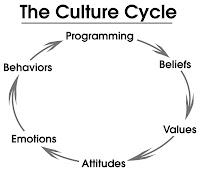
1. This is a cycle. It repeats itself daily. These are not stages over time: rather, they are a daily routine that feeds your culture - either reinforcing it or modifying it. When your company first started, this cycle was more of a stage-development process. Today you have a mature culture, which has already developed. You are looking to change this “adult” and the change follows the same cycle.
2. If this is a cycle, then it must follow the sequence outlined. You cannot let the people on the bus until the door is open and you cannot start the bus until there is gas in the engine. These facts about your culture bus are true for your culture cycle as well. There are no shortcuts in this process, so do not try.
The culture cycle states that your culture’s programming determines your beliefs, and beliefs determine your values, and your values determine your attitudes, and your attitudes determine your emotions, and your emotions determine your culture’s behaviors. As you can see, the cycle builds upon itself with each step. You cannot have a set of values until you have determined your belief system. You cannot control attitudes until you understand the values of your culture.
I am making this post today because this principle is at the core of everything I believe about corporate culture. And also, because it is at the core of why 90% of culture change initiatives fail.
For more on this topic, see Culturrific! available on Amazon.com
Subscribe to:
Posts (Atom)

 Posts
Posts

